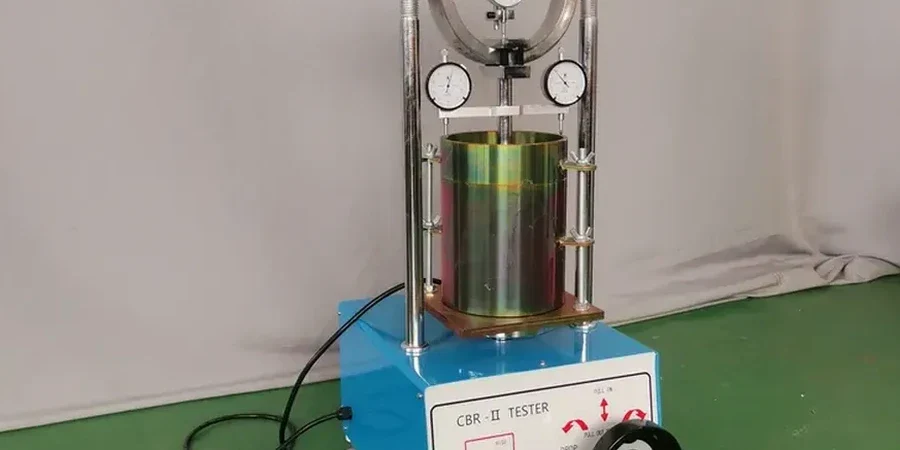
The loading press hums at a controlled 0.05 inches per minute. A cylindrical plunger, three square inches in cross-section, pushes into a compacted soil specimen submerged in water for four days. That is the laboratory California Bearing Ratio test running inside our Wilmington-bound program. We follow ASTM D1883 without deviation. The setup looks simple, but the data it produces determines pavement thickness, aggregate base depth, and whether on-site material in New Castle County can carry design traffic. Wilmington sits at the confluence of the Christina and Brandywine rivers, where alluvial silts and residual Piedmont clays meet. These soils demand CBR values before any roadway, parking lot, or industrial yard gets approved. We run soaked and unsoaked specimens side by side. No shortcuts. No assumed correlations. Just direct penetration resistance measured under strict moisture control. SPT drilling provides field blow counts, but the lab CBR ties that number to a design modulus for pavement structural sections.
A CBR value of 3 demands removal or stabilization. You cannot negotiate with that number.
Technical details of the service in Wilmington Delaware
Typical technical challenges in Wilmington Delaware
Wilmington's industrial expansion during the DuPont era left a legacy of undocumented fill across the riverfront and the Seventh Ward. Brick fragments, cinders, and dredged silt were used to level ground for factories and rail spurs. Today those parcels are being redeveloped into mixed-use and logistics centers. A CBR test on natural ground tells one story. A CBR on fill containing 1920s debris tells a completely different one. We have seen values swing from 12 to 2 within the same lot. Ignoring that variability leads to differential settlement under rigid pavement and fatigue cracking within the first two winters. The IBC and ASCE 7 require subgrade characterization for any engineered fill placement. The CBR is not just a design input; it is a forensic tool that reveals whether the ground beneath Wilmington's post-industrial skin can actually support what the architect drew.
Our services
Our Wilmington program covers the full chain from sample extrusion to signed report. Everything happens in one laboratory under one quality system.
Soaked CBR
Four-day submersion per ASTM D1883. Measures bearing capacity under worst-case moisture conditions.
Unsoaked CBR
Immediate penetration after compaction. Used for comparison and for arid-condition design scenarios.
Compaction curve pairing
We run the Proctor first. The CBR specimen is molded at the target moisture and density from that curve.
Subgrade modulus correlation
We convert CBR to k-value and resilient modulus for use in Westergaard and AASHTO pavement design methods.
Questions and answers
What is the typical cost for a laboratory CBR test in Wilmington?
A single-point CBR test, including the compaction curve, ranges between US$120 and US$240. The final cost depends on whether we run soaked, unsoaked, or both conditions and how many points the project requires.
Why is the sample soaked for four days?
The four-day soak simulates the most critical moisture condition the subgrade will experience during the pavement's service life. It measures the strength loss caused by saturation, which is essential in Wilmington's high-water-table zones.
How is CBR value used in pavement design?
The CBR number determines the required structural number and layer thicknesses. A CBR of 3 requires a significantly thicker aggregate base than a CBR of 10. It feeds directly into AASHTO and state DOT design catalogs.