The triaxial cell is pressurized and the loading frame starts the shear stage. That is the moment when the soil sample from your Wilmington site reveals its real strength. We run these tests in our lab with equipment calibrated to ASTM D4767. A soil mechanics study is not just a report. It is the friction angle, the cohesion intercept, and the consolidation curve that define your foundation geometry. In Wilmington, where the Fall Line crosses the city and transitions from Piedmont rock to Coastal Plain sediments, the subgrade changes drastically within half a mile. We see it every week. Samples from the Riverfront area behave completely different from those near Brandywine Park. For deeper characterization we pair the lab program with field data from spt drilling to correlate N-values with undrained shear strength. That combination saves time and avoids overdesign.
A consolidation test on Wilmington organic silt can show Cc values above 0.35 — meaning over 2 inches of settlement if foundation design ignores the lab data.
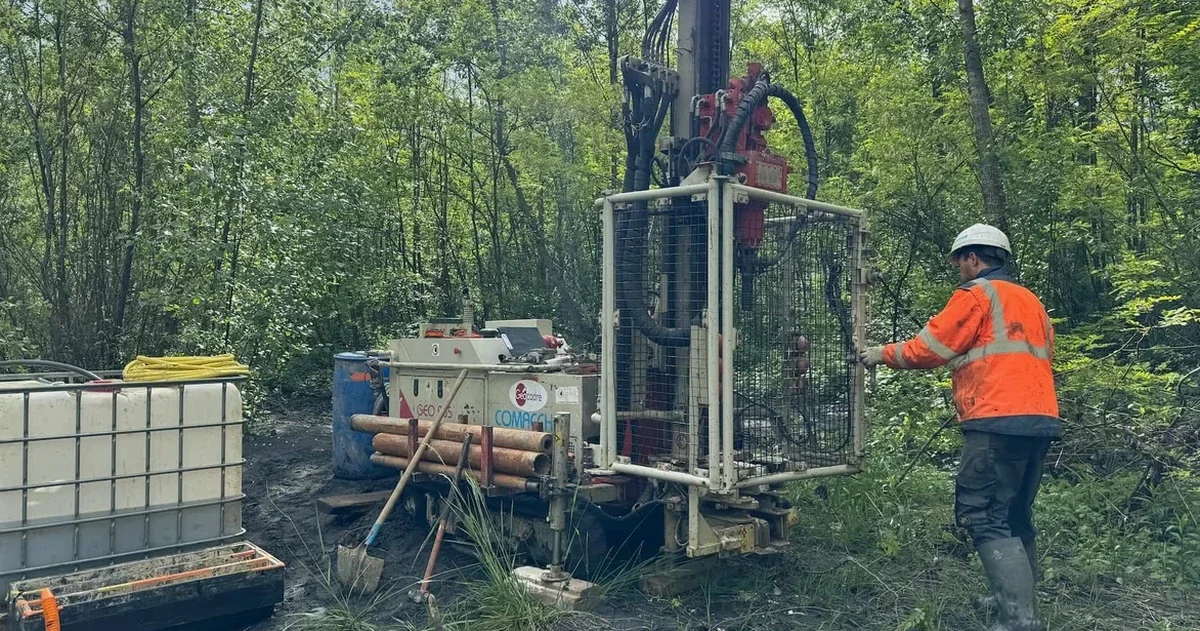
Technical details of the service in Wilmington Delaware
Typical technical challenges in Wilmington Delaware
Wilmington grew along the Brandywine and Christina rivers starting in the 1730s. Much of the downtown sits on historic fill. Old mill foundations, buried wharf timbers, ash, and brick rubble are common in the upper 10 feet. This legacy creates a geotechnical risk that standard exploration can miss. A soil mechanics study on fill material often reveals erratic strength and high compressibility. Differential settlement becomes the primary failure mode. The 2017 Delaware River flooding also reminded us that groundwater here rises fast after heavy rain. Our lab tests account for saturated conditions because that is the worst case for bearing capacity and slope stability. When fill is thick or contaminated we recommend complementing the study with test pits to visually log the fill matrix and identify obstructions before finalizing the foundation type.
Our services
The soil mechanics study integrates field sampling and lab testing into a single engineering deliverable. Each component targets a specific design parameter needed for foundation calculations, excavation support, or pavement design.
Strength and Deformation Testing
Triaxial compression (UU, CU, CD) and unconfined compression to determine shear strength parameters c' and φ'. Consolidation tests provide settlement magnitude and rate. These results feed directly into bearing capacity and settlement calculations per Vesic and Meyerhof methods.
Index and Classification Tests
Atterberg limits, particle size distribution, specific gravity, and moisture content per ASTM standards. We classify soils using USCS (ASTM D2487) and AASHTO systems. The PI and gradation data flag frost susceptibility and drainability issues early.
Specialized Lab Analysis
pH, sulfate content, and organic matter (LOI) for concrete durability assessment. Swell-consolidation on expansive clays from the Piedmont residual soils. We run these tests when the site is near the Fall Line transition zone where weathered rock meets marine sediments.
Questions and answers
What does a soil mechanics study include for a typical building project in Wilmington?
It includes field sampling via SPT borings or test pits, followed by lab tests: moisture content, Atterberg limits, particle size distribution, unconfined compression or triaxial shear, and one-dimensional consolidation. The report provides shear strength parameters, settlement estimates, and foundation recommendations per IBC 2021 and ASCE 7.
How much does a soil mechanics study cost in Wilmington?
A complete soil mechanics study with field drilling and lab testing typically ranges from US$2,980 to US$4,810 depending on the number of borings, depth, and lab tests required. Projects with deep fill or compressible organic layers need more consolidation tests and triaxial specimens, which sit at the upper end of the range.
How long does the lab testing take?
Standard index tests take 3 to 5 business days. Consolidation tests need 7 to 10 days because each load increment requires 24 hours for primary consolidation. Triaxial tests with pore pressure measurement add another 5 to 7 days. We can expedite with multiple setups if the project schedule demands it.
Do you test soils from the Coastal Plain differently than Piedmont residual soils?
Yes. Coastal Plain sediments near the Delaware River are often saturated silts and clays with high compressibility. We focus on consolidation and CU triaxial with pore pressure measurement. Piedmont residual soils from the northwestern part of Wilmington are stiffer and sometimes expansive. We run swell-consolidation and check PI values to flag heave potential.
Can a soil mechanics study help with differential settlement problems?
Absolutely. That is one of its main purposes. By testing compressibility and strength at multiple depths and locations, we identify zones with different stiffness. The report quantifies total and differential settlement so the structural engineer can design foundations, grade beams, or mat foundations that keep angular distortion within tolerable limits.