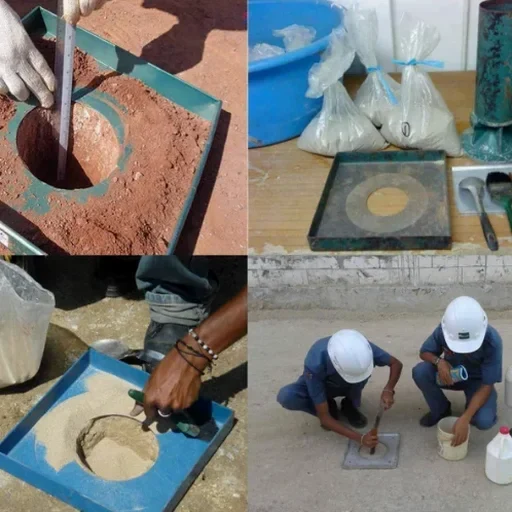
The IBC and local Delaware building codes don’t leave much room for interpretation when it comes to compaction. Section 1803 requires fill verification, and in Wilmington’s complex soil profile—where Piedmont schist meets Atlantic Coastal Plain sediments—the sand cone method delivers the direct field data that nuclear gauges can’t always capture cleanly. ASTM D1556 outlines the procedure, and it’s the standard reference for a reason: you extract a physical sample, weigh it, and get a dry density number that holds up in front of any geotechnical reviewer. In a city where construction ranges from Christina Riverfront brownfields to suburban subdivisions near Brandywine Creek, the difference between a passing lift and a settlement headache often comes down to a well-executed field density test. We run these tests alongside our SPT drilling program when the project scope requires both bearing capacity and compaction control, saving you a second mobilization.
A sand cone test doesn’t estimate density—it measures it directly, and that distinction matters when a failed compaction lift can delay a project by weeks.
Technical details of the service in Wilmington Delaware
Typical technical challenges in Wilmington Delaware
The redevelopment of Wilmington’s historic districts—from the Quaker Hill brownstones to the converted warehouses along the Brandywine—has exposed a recurring problem: undocumented fill from a century of industrial use. Old brick fragments, ash, and mixed debris sitting under a few feet of cleaner cover material can settle unevenly under load, even if the top lift passes compaction. The sand cone test helps identify low-density pockets that a proof roll might miss, especially in irregular fill where nuclear gauge readings become unreliable due to chemical interference or variable moisture. Skipping field density verification on these sites isn’t just a technical shortcut—it’s a liability that shows up later as cracked slabs, separated utilities, or stormwater detention structures that tilt out of tolerance. For projects near the Christina River’s floodplain, where the water table sits high and backfill saturation is a real concern, a liquefaction assessment may also be warranted if the fill depth exceeds ten feet.
Our services
Our Wilmington field density services cover the full compaction control workflow, from pre-construction Proctor references to final lift acceptance. Each test includes a calibrated sand cone kit, certified Ottawa sand, and a report formatted for Delaware permitting agencies.
Field compaction verification (sand cone)
In-place density testing per ASTM D1556 for structural fill, utility backfill, and pavement subbase. We test each lift individually and provide immediate pass/fail results so your earthwork crew can adjust compaction effort on the spot.
Proctor reference testing
Laboratory standard and modified Proctor curves (ASTM D698 / D1557) on your project fill material. Running these before field testing establishes the maximum dry density and optimum moisture content that the sand cone results are measured against.
Questions and answers
What does a sand cone density test cost per test in the Wilmington area?
For projects in Wilmington and northern Delaware, a single sand cone field density test typically runs between US$100 and US$150 per point, depending on site access and the number of tests scheduled in a single visit. Mobilization may be additional for small projects. We recommend grouping at least six to eight tests per day to keep unit costs efficient.
How many sand cone tests does IBC require for a commercial building pad in Delaware?
The IBC doesn’t prescribe an exact number—it’s performance-based. The geotechnical engineer of record determines the testing frequency based on fill type and project risk. A common specification in Wilmington is one test per 2,500 square feet per lift, with a minimum of three tests per lift for pads under 10,000 square feet.
Can you perform sand cone tests on gravelly fill or crushed stone base?
ASTM D1556 is best suited for soils with a maximum particle size of about two inches. For clean crushed stone or open-graded gravel, the void space around large particles makes the sand cone less accurate. In those cases, we often recommend a plate load test or a nuclear density gauge with proper correlation to verify compaction.