Drilling in Wilmington means dealing with the Columbia Formation up top and the Potomac Formation below. The transition zone catches a lot of designers off guard. We run SPT borings here every week and the split-spoon recovery in that silty sand layer tells you more than any CPT cone ever will. Our crew uses automatic trip hammers calibrated to ASTM D1586 energy ratios. No guesswork. We pair the SPT with grain-size analysis right in our lab to lock down the USCS classification before the foundation engineer even asks. That speed matters when the building permit clock is ticking at the Louis L. Redding City/County Building. We also cross-check soft zones with CPT soundings when the client needs continuous stratigraphy for liquefaction screening under ASCE 7-22 Chapter 11. Wilmington sits at the Fall Line. The soil changes fast. Our borings prove it every time.
Blow counts don't lie. In Wilmington's Fall Line soils, N-values under 10 at footing depth mean either deep foundations or ground improvement — no middle ground.
Technical details of the service in Wilmington Delaware
Typical technical challenges in Wilmington Delaware
Wilmington sits in a moderate seismic zone with Site Class D and E soils dominating the subsurface east of I-95. The USGS hazard maps put the 2,475-year spectral acceleration at 0.15g to 0.20g for short periods. When SPT N-values drop into single digits in saturated sand, liquefaction becomes a design check you can't skip. We watched a boring near the Amtrak maintenance yard hit loose sand at 18 feet and the water table at 14 feet — that combination triggers a mandatory liquefaction assessment under ASCE 7 and the Delaware Building Code. The same boring hit weathered rock at 55 feet. Depth to refusal varies sharply across the city. Assuming uniform conditions across a site larger than half an acre is a risk no geotechnical report should take. Our SPT data feeds directly into liquefaction analysis and seismic microzonation studies for projects that need a peer-reviewed ground motion assessment before the structural engineer locks the foundation design.
Our services
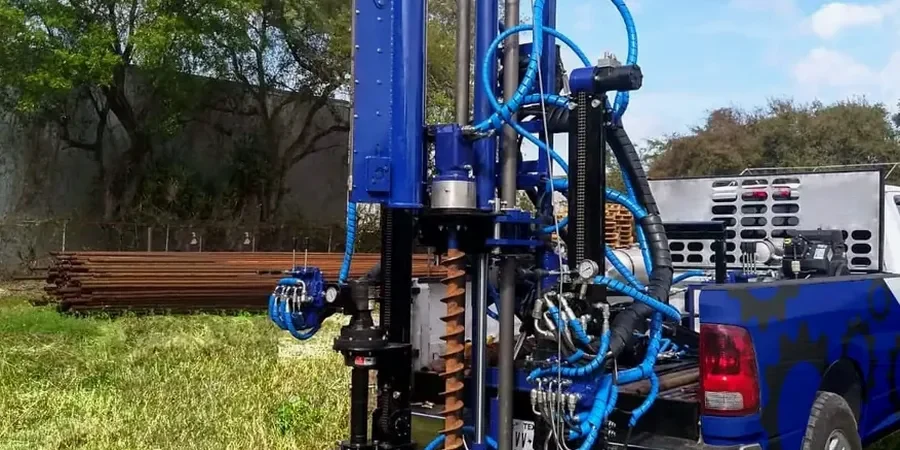
We run SPT borings across New Castle County with two rigs and a lab that turns samples around in 48 hours. Every project gets a Delaware-licensed geotechnical engineer signing the log.
SPT Borehole Drilling and Sampling
Hollow-stem auger borings to 100 ft depth. Standard split-spoon sampling every 5 ft. On-site logging, groundwater measurement, and sample transport under chain-of-custody to our New Castle lab. N60 values reported with hammer energy calibration.
Laboratory Testing Package
Grain-size distribution by sieving, Atterberg limits, natural moisture content, and USCS classification. Results in 48 hours. We run the lab ourselves — no third-party delays.
Questions and answers
What does an SPT boring cost in Wilmington?
A standard SPT boring to 30 feet depth with sampling every 5 feet and a basic lab package runs between US$520 and US$760 per hole. Mobilization, traffic control in downtown Wilmington, deeper borings, or additional Shelby tube sampling adjust the final number. We quote by the site, not by the foot, after reviewing the boring plan.
How deep do you typically drill for a standard SPT investigation?
Most commercial projects in Wilmington go 30 to 50 feet below grade. We extend deeper when pile design requires rock socket information into the Potomac Formation gneiss or when loose sand layers below the water table demand a liquefaction assessment to greater depths.
How long until I get the boring logs and lab results?
Draft boring logs leave the field with the crew. Final logs with N60 corrections and lab data are delivered within 3 to 5 business days. Rush turnaround in 48 hours is available when the foundation contractor is waiting to mobilize.