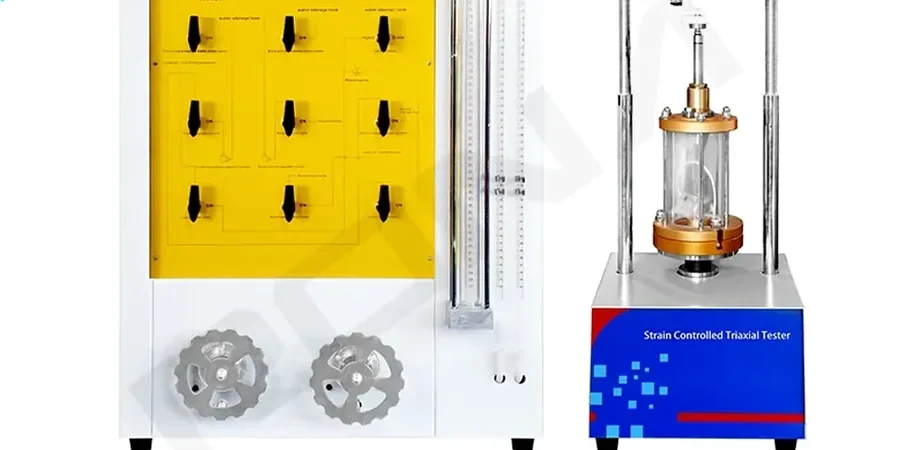
Wilmington splits into two distinct geologies. North of Brandywine Creek you hit weathered Wissahickon schist with stiff residual silts. South toward the Christina River, it's deep Coastal Plain sediment—loose sands and soft clays that compress under load. A footing design that works near Rodney Square can fail completely three miles south. That's where the triaxial test becomes essential. It gives us the drained and undrained shear strength parameters neither the SPT blow count nor a pocket penetrometer can provide. When your site investigation crosses from rock-controlled to soil-controlled behavior, we run consolidated-undrained and unconsolidated-undrained triaxial series to nail down the friction angle and cohesion the design actually needs. For deeper soft zones near the port, we often pair triaxial data with a CPT test profile to map pore pressure buildup before excavation starts.
An unconfined test on Wilmington's Potomac clay can read 40% low—a triaxial test with proper saturation and consolidation gives you the strength the soil actually has.
Technical details of the service in Wilmington Delaware
Typical technical challenges in Wilmington Delaware
A seven-story mixed-use structure planned along Market Street hit an unexpected layer of organic silt at 18 feet. The preliminary bearing capacity calculation used SPT N-values alone and assumed a friction angle of 32 degrees. Our triaxial test on undisturbed Shelby tube samples from that layer returned an effective friction angle of 24 degrees with a cohesion intercept under 100 psf. That 8-degree difference dropped the allowable bearing pressure by nearly 40%. The structural engineer had to widen the mat foundation footprint and add a ground improvement specification before the building permit could proceed. In Wilmington's transition zones—where Piedmont residual soil meets Coastal Plain alluvium—the soil type can change over a distance shorter than the building footprint. A single triaxial series costs a fraction of a redesign during construction or, worse, a foundation failure discovered years later.
Our services
Our Wilmington triaxial testing program covers the full range of shear strength determination. We handle sample extrusion, specimen preparation, and multi-stage testing under the stress paths your project requires.
Consolidated-Undrained Triaxial (ASTM D4767)
CU triaxial with pore pressure measurement for effective stress analysis. We saturate specimens to B-values above 0.95, consolidate at three confining stresses bracketing the in-situ overburden, and shear at 0.01 in/min. You get the Mohr-Coulomb envelope with φ' and c' parameters ready for long-term stability analysis.
Unconsolidated-Undrained Triaxial (ASTM D2850)
UU triaxial for total stress undrained shear strength. We run these at confining pressures matching expected field conditions. Results deliver Su values for short-term bearing capacity checks, temporary excavation stability, and embankment construction sequencing.
Questions and answers
What does a triaxial test cost in Wilmington?
A standard three-specimen CU triaxial series with pore pressure measurement runs between US$1,950 and US$2,450, depending on specimen diameter and whether we need to extrude and trim Shelby tube samples or you send pre-trimmed specimens. UU series are at the lower end of that range. Expedited 7-day turnaround adds a surcharge.
How long does a triaxial test take from sample to report?
A CU triaxial series typically takes 10 to 14 business days. Saturation and consolidation phases alone can take 3 to 7 days on Wilmington's low-permeability silts and clays. We do not rush saturation—an under-saturated specimen produces meaningless effective stress data. UU tests are faster, usually 5 to 7 business days.
Do I need CU or UU triaxial for my Wilmington project?
It depends on the drainage condition of your design scenario. If you are analyzing long-term slope stability, retained cut performance, or final foundation settlement, you need CU with pore pressure measurement to get effective stress parameters. For short-term construction conditions—temporary excavation, embankment loading, or footing bearing capacity during construction—UU total stress parameters are appropriate. Many projects in Wilmington's soft river deposits require both.
What sample quality do you need for a reliable triaxial test?
Undisturbed Shelby tube samples are the minimum. We inspect every tube for signs of disturbance—cracks, gaps at the tube wall, water accumulation—before extruding. Samples that show significant disturbance get downgraded or rejected. For critical infrastructure near the Christina River, we recommend piston sampling or block sampling to preserve the in-situ fabric of sensitive silts and clays.